
Before I begin, I want to provide an offer to everyone who was disappointed with the performance after July. You can read the portfolio update at the end of last weekend's article here Q4: What is next for the stock market and Portfolio Update.
Get 50% Off Regular Tier or 70% off Founding Tier before offer expires at at the end of Friday, October 24. Price in the sign up page should show $25/month or or $250/year for regular tier and $750/year for founding tier until offer expiry. If you are seeing higher price, sign up using desktop because Android and Apple os adds extra fees to app purchases on mobile and don’t show the breakdown. Even with the discount, this offer is still backed by our usual 12-month guarantee: if the 12 consecutive months from the date you join do not generate at least a 50% gain in any of our main 3 portfolios, your subscription access to that tier will be renewed free of charge for an additional 12 months.
I fully expect us to recover our recent losses and push past our previous all-time highs by January Opex and as usual the founding tier options only portfolio is the one that will gain the most. The purpose of this offer is to give every newcomer who left the paid tier a fair opportunity to witness this rebound first-hand. This is also a great opportunity for anyone else who couldn’t join us in the past because the subscription cost was out of reach.
Now lets Get to the topic of this article!
Both polls and prediction markets are forecasting Democrats sweep of Congress in November barring an “October surprise”.
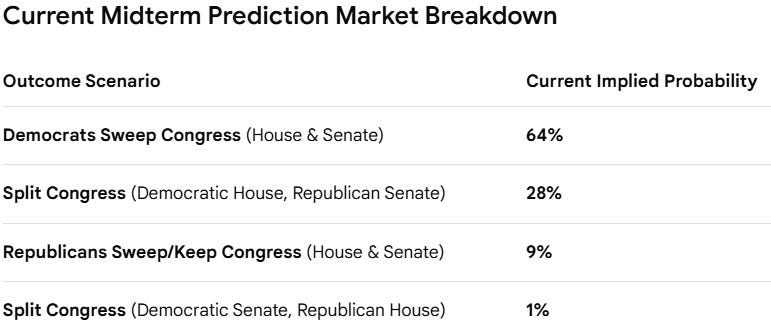
The House: Democrats reclaiming the House is considered highly likely in both major markets, Kalshi and Polymarket, pointing to a 91% to 92% chance of a Democratic majority.
The Senate: Control of the Senate remains the primary battleground. While a net gain of four seats is a steep climb, current market consensus favors a Democratic flip at 64%, fueled by tightening races in traditionally Republican-held seats like Texas, Maine, and Alaska
Does Results Matter?
The midterm election results matter significantly for both the war with Iran and the future of AI regulation, despite the massive influx of lobbying money from groups like AIPAC and major tech companies to both sides. While it is true that special interests spend hundreds of millions of dollars across party lines to influence swing-state Democrats and establish broad baselines of political access, the final balance of power in Congress directly determines the legal and financial boundaries within which these issues operate.
Iran War: The midterm election results directly impact the conflict with Iran because they dictate the constitutional limits and financial boundaries of U.S. military power. While lobbying buys access, a newly empowered congressional majority can use its power of the purse to restrict or completely choke off war funding, or invoke the War Powers Act to legally demand a withdrawal of forces and halt further escalation. Ultimately, these midterms serve as a critical public referendum; if voters express heavy backlash over the war’s impact on gas prices and the cost of living, any administration will be forced to pivot away from a land conflict and toward a diplomatic exit. The likely outcome, regardless of the election results, is limited ground action that Democrats who accepted the most AIPAC funding will have no problem supporting. Amphibious forces like the Marines and the 82nd Airborne Division could be deployed to seize strategic islands in the Strait of Hormuz (such as Qeshm, Larak, or Abu Musa) or to temporarily occupy Kharg Island (which handles 90% of Iran’s oil exports) to break the maritime chokehold. A full-scale invasion is unlikely due to Iran’s terrain, which presents a severe strategic disadvantage for foreign militaries. Successfully invading Iran would require over 1 million military personnel and the reinstatement of the draft in the United States. If the U.S. begins a draft, a full-scale invasion could be expected within 6 months.
Artificial Intelligence: The midterm election results directly shape the future of artificial intelligence because the winning party dictates whether the industry faces strict regulation or continued growth. While tech lobbying secures political access and local data center approvals, the congressional majority controls the legislative framework, determining whether the U.S. passes stringent anti-trust and data privacy laws or favors a laissez-faire approach with tax breaks and deregulation. Furthermore, because AI is increasingly central to modern warfare, whichever party controls key congressional committees will hold the unique power to subpoena tech executives, mandate algorithm transparency, and tightly restrict or expand government defense contracts. While the midterm results will definitely bring some political drama and new rules, they aren't going to stop the massive AI train from moving forward. Tech companies have poured hundreds of billions of dollars into these massive data centers; the ground is dug, construction is well underway, and no one is going to cancel these projects now. Even if critical Democrats win and push for tougher oversight, the tech lobby has already funded the exact lawmakers they need to make sure the core building keeps moving and the big money stays protected.
Stock Market: As for the market, the long-term trend looks solid and this bubble isn't bursting next year regardless of who wins. Near term however there will be headline drama and year-end tax harvesting will create many good opportunities. We’ll also need a correction down the road to test the 200-day moving average. This correctly likely breaches below 200 MA and teases bear market territory if it waits until next year to begin.
Trading Opportunities Ahead
As mentioned in my previous article from last Sunday, instead of continuing to wait for the correction, I will be getting very active as early as this week to take advantage of the downside and upside of certain names that are starting to line up nicely. One of them is Tesla. TSLA 0.00%↑ looks like an excellent short candidate from above 380 but I am waiting to see post earning action to see if it will test the 400 gamma level. As I type this, post earnings after hours it went as high as 395 but retreated into the 370’s now around midnight. I would like to see it test the 395-400 area during regular trading hours.
While I like Tesla (TSLA) as a long-term buy if it drops into the $200s, it faces serious downward pressure at its current $380 price tag, where a mix of rising interest rates and a cyclical year-end flush—mirroring the mid-term market patterns of 2022—could easily push the stock below $300 to test the $290 support, and if that fails, the $250 level before January Opex. The upcoming election will trigger massive volatility in stocks like this, and since TSLA opened the year at $458, failing to break above the $395–$400 resistance for a short squeeze into the $450s will invite heavy tax-loss harvesting selling pressure. Compounding this chaos, Cathie Wood’s wild price targets of $4,400 and $5,000 are sparking intense retail FOMO, creating the perfect recipe for a bull trap where fake bounces lure in retail buyers right before the real pullback hits.
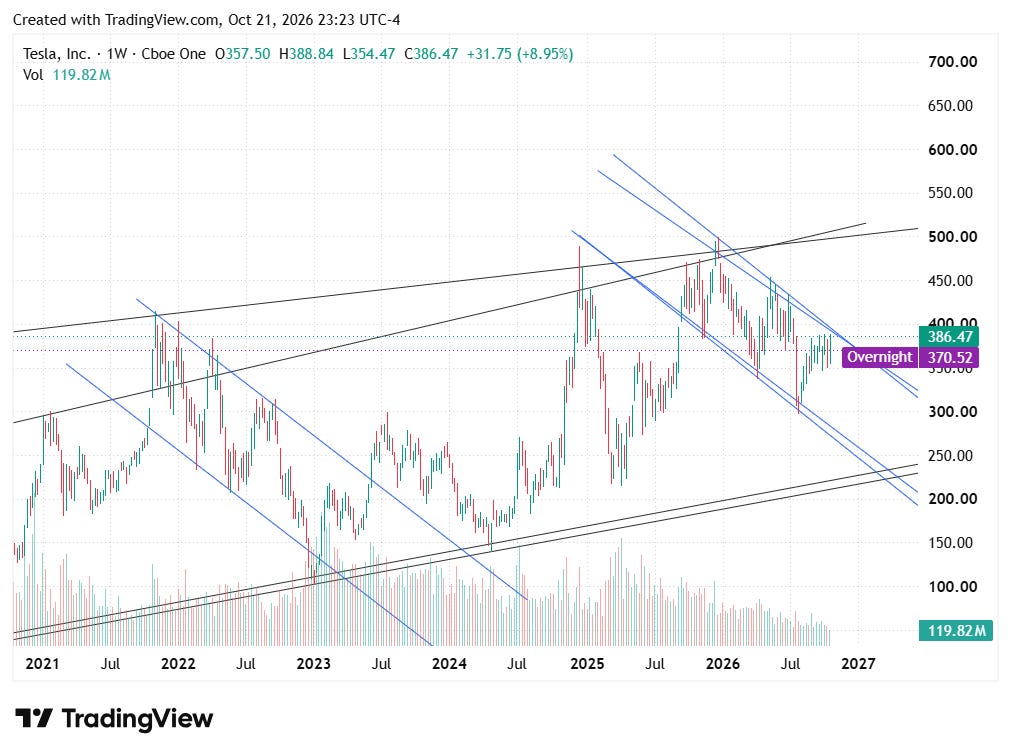
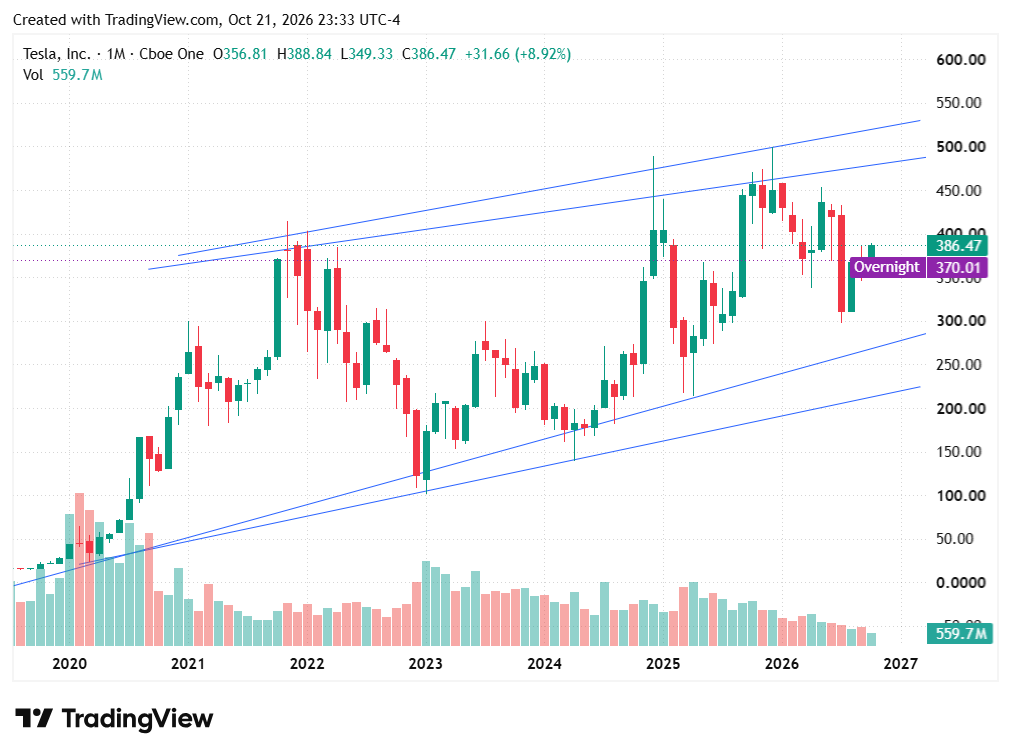
To be absolutely clear, I have not entered any positions yet. But I have this as a potential short candidate depending on how it trades after earnings. If the short qualifies and if I enter, I will also look for some careful option entries to get in and out on the weeklies and monthlies. If you are trading options, don’t FOMO and buy/sell at the wrong time. If Tesla doesn’t meet the criteria to enter in the coming days or weeks, there are more than a handful of stocks, both longs and shorts that I am watching closely to take advantage and everything that I enter will be shared in the subscriber chat in the respective portfolios the moment I enter.
