
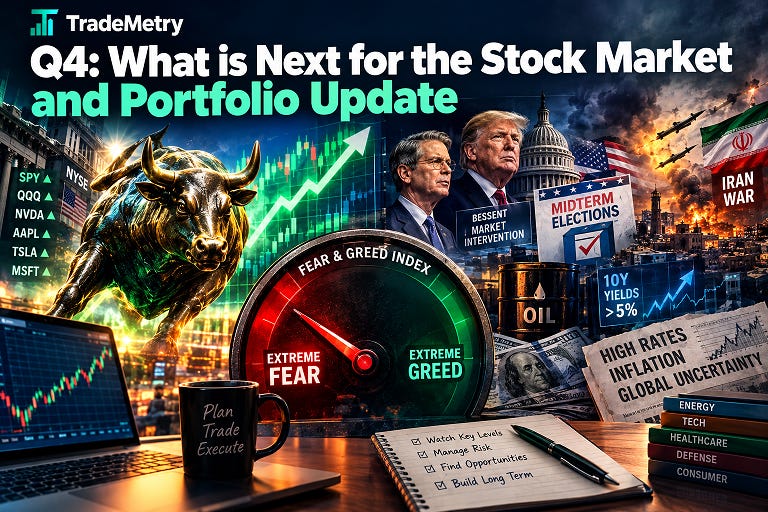
We maintained an incredibly accurate forecasting run across the markets in 2026, leading up to August 3rd, and reaped the benefits. Since that date, however, the market has transitioned into a textbook stealth phase. Current price action provides a clear example of this dynamic, where index-level resilience masks widespread under-the-surface damage. While the Trademetry portfolio as a whole remains significantly positive for the year, we have given back a good portion of our peak gains due to a directional bias that anticipated the indices would, at a minimum, test their 200-day moving average (DMA). We will analyze our performance metrics in detail in this article further down, following our broader market analysis.
Prerequisite:

If you haven’t read our previous articles and the other pieces referenced within them, you may want to catch up, because this piece will mainly be an update without going too much into detail.
At index level (SPY/QQQ) the correction didn’t test the bare minimum (200dma), which translated to around 700 for spy and 640 for QQQ depending on when in Q3 you looked at, which I needed to consider any bottom shopping. Instead QQQ bounced back near 660 and SPY bounced back near 725. We saw QQQ and SPY sneakily drag themselves to new ATH few times briefly only to keep falling back inside the June 7th range we set.
While headline indices like the SPY and QQQ continued to drag themselves to all-time highs, a stealth bear market played out beneath the surface in the majority of the index components, and that did not help our portfolios. The surface calm was an illusion driven by heavy mega-cap concentration, hiding the fact that a massive internal rotation was underway. To put it into perspective, throughout Q3, even though the S&P 500 went to ATH, over 50% of its components traded below their 200DMA. On October 1, a whopping 60% of its components traded below their 200DMA. During normal conditions, at ATH, we might see at worst 25% of the components trading below their 200DMA.
But these are not normal times. There are too many uncertainties this election year and an administration like never seen before. In early August, U.S. Treasury Secretary Scott Bessent surprised markets by doubling long-term bond buybacks from $2 billion to $4 billion per operation. The move faced heavy backlash from Wall Street, economists, who warned it politically manipulated debt markets to artificially lower borrowing costs ahead of the midterm elections. It also prompted billionaire investor Stanley Druckenmiller to slam the policy in a Wall Street Journal op-ed, declaring that “governments defending prices against fundamentals always lose” and warning against suppressing natural market yields.
IWM (Russell 2000) and XLF (Financials) breached their 200DMA. The Dow Jones came very close to its 200DMA but did not breach it. Oil is consistently flirting near its March highs. Yields are another story. Japan and the U.S. raised rates in September, and as of now, there is an 88% probability that both will raise rates one more time before the year is over! Through all this, SPY and QQQ still traded at ATHs before pulling back last week. This price action is a textbook example of a stealth market phase, where index-level resilience masks widespread under-the-surface damage. While the broader averages defied the expected timing by hitting highs, the structural breakdown across individual market components played out but did not help our portfolios. The correction simply chose to play out quietly through internal stock dispersion rather than a loud, index-wide panic.
So what’s in the store for markets now?
As I write this, the CNN Fear Index is at extreme fear.

Extreme fear while spy is only down slightly over 2% from ATH!
Financial markets entering the final stretch of Q4 are caught in a major tug-of-war between strong economic growth and the pressure of high interest rates. On one side, company earnings are giving the market a big boost, especially with a massive wave of reports coming from nearly half of the S&P 500’s biggest companies between late October and early November. Because tech giants are spending heavily on AI infrastructure and data centers, big Wall Street firms are staying very optimistic, betting that stocks will surge even higher toward the 7,800 to 8,100 range on the S&P 500. Plus, a steady U.S. economy with GDP growing at a solid 2.9% keeps giving this long-term bull market a strong foundation.
On the flip side, this stock market optimism is running into a wall in the bond market, where 10-year Treasury yields have shot past 5% to highs we hasn’t seen in decades. This jump is happening because core inflation is stuck above 3.4%, global oil prices are high, and the government keeps borrowing heavily. These high yields make bonds look a lot more attractive than stocks, pushing the S&P 500’s dividend yield down to a near-record low of 1.07%. To protect themselves from these conflicting forces, big institutional investors have set up a massive safety net by buying a lot of put options between the 7,500 and 7,650 levels to hedge against a sharp drop. Because of this, the rest of Q4 is looking like a bumpy ride where the market could easily see burst of rallies rally or take a sudden dive on macro news. Basically continuation of recent stealth style price action but with bit more volatility.
During the second half of October, those downside puts on 7500 will likely get tested, taking SPY below 750, but a rally should soon follow considering we are already at extreme greed in the fear index. Even if SPY and QQQ are to go to their 200-DMAs, they would still be higher than previous lows due to the rise of the 200-DMA, setting up for a rally. However, making any longer-dated directional bets in current market conditions is fruitless, which we learned the hard way in August. The final week of October and the first week of November will be a turning point for many stocks, ETFs, and indices, for better or worse, with the FOMC meeting on October 29th, Midterm elections on November 3rd, and the QRA announcements on November 2nd and 4th.
As of now, barring any “October surprise” Democrats are expected to win the House easily, while the Senate is up in the air with a tight race slightly favoring Democrats. Markets are eagerly waiting for the election results because the impending policy shifts will play a key role in many sectors, especially ai data center regulations. Nothing is expected to happen at the upcoming October FOMC and BOJ meetings other than some commentary; however, the meeting in December is a big one because, as of now, both the BOJ and the Fed are expected to raise rates, as the probability of a hike stands over 88%.
If the market continues higher, we cannot get bullish confidently, but we can confidently trade a handful of individual names in the correct sectors each for both upside and downside moves. There will be many of opportunities. In fact, there were plenty of opportunities last quarter where some stocks reached my buy levels, but I didn’t buy because I was waiting for the indices to bottom. As a result, I watched without holding as some of these names gained more than 100% from the levels I had designated as buys! As for the overall market, at the moment is not a good time to do forecast that looks past 2 weeks because of many events waiting for outcome.
Portfolio Update
Overall, the last three months were tough for the portfolios, even though almost all of our core correction trades via share buys performed well. Shares wise, we bought mostly into the Oil and Gas sector, and those positions are currently green and remain in the portfolio. Despite our broader bearish outlook in Q3, we managed to buy SPCX (space x) right at the bottom near $110 and trading it successfully in the investor portfolio.
The real drag on performance came from over-aggressive options trading across all portfolios throughout August and early September. We finished July with massive returns for 2026 and held a large pile of cash after taking profits. Unfortunately, I went overboard with options, doubling down on a market correction, and the subsequent price action humbled me. I also mismanaged the $25k Challenge portfolio by leaning too heavily into options, which nearly wiped it out—though it is still alive.
Because of those lessons, September and October have been much quieter observation periods. I have spent this time building a specific strategy and waiting for key market catalysts to line up. Now, we are finally at that turning point. Our next three-month cycle, which marks the end of the first half of our second year, concludes with the January options expiration. I strongly believe we can recover our losses and push the total portfolio value past its previous all-time highs by then.
In terms of portfolio volatility, this recent stretch mirrors our experience in 2025. Back then, after the inception of our portfolios we had an epic run, followed by a stagnant three-month period, before launching into massive rally in 2026 until end of July. The mistakes during both negative period is same: Got aggressive with options directionally right when market went on choppy stealth mode. I will try not to make the same mistake after our upcoming portfolio rally to close the year.
Below are the portfolio summaries as of Oct 16, 2026 market close.
Trademetry Mixed Stocks and Options Swing Trading Portfolio: Launched June 23, 2025 with 100k.

Trademetry Founding Tier Options Only Portfolio: Launched Jul 9, 2025 with 100k.

Trademetry Investor Portfolio: Launched July 20, 2026 by moving 250k of the gains from the Options Only portfolio.

Trademetry 25k to 100k Challenge #1 Portfolio: Launched July 20, 2026 by moving 25k of the gains from the Options Only portfolio.

Original investment 200k.
Combined 2025 Gains +42137.8 (242137.8 portfolio value)
Combined 2026 Gains as of July 18, 2026: +288,097.26 (488,097.26 portfolio value)
Combined 2026 Gains as of Oct 16th, 2026: +183122 (383122 portfolio value)
The combined portfolio value experienced a -21.5% dip during the last 3 months but still up +58.23% for the year 2026 and +91.56% since inception.
After market humbles me I always come back strong and I doubt this time will be any different. With mid terms and almost here, things should get in our favor and we should be able to take the portfolios to new highs. You can follow all entries in the subscriber chat as they happen and full transaction log since inception is updated every week.
